

What is yoga nidra
Frequently Asked Questions
What IS yoga nidra / nsdr?
It looks like we’re doing nothing… but the magic occurs inside of your body. The physiology that is occurring in Nidra is practically mystical.
-
A strategy of techniques with the goal of stepping down to slower brainwave states to increase your time in the hypnagogic state. Increasing the time our body can experience the states of delta and theta brainwaves. These states of the body are what I would consider to be the physiological state of resilience, recovery, creativity, problem solving, memory development, focus and emotional regulation.
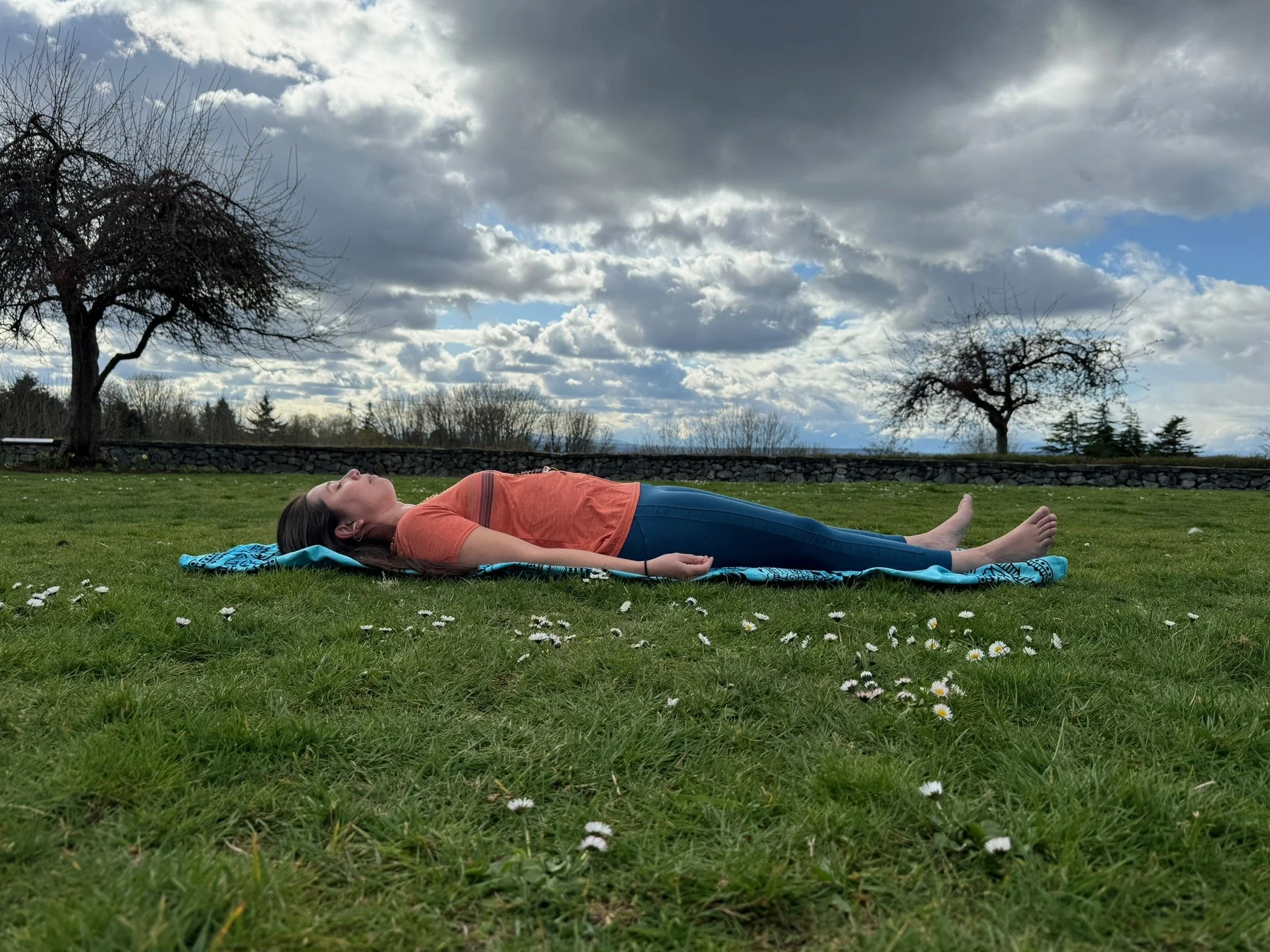
It is generally practiced on your back, lying still, with no body parts touching (legs hip width a part, arms away from the body with zero strain to shoulders). Eyes have a soft gaze or are closed. We are slowly withdrawing from our sensorial experience of the external world and turning up the volume of the sensorial experience of our internal world.
Which can in turn feel overwhelming from time to time, which is why is it called a practice.
other common questions
-
Yoga Nidra / NSDR has a lot of health benefits. Through awareness you're kind of 'recalibrating' your nervous system. Once the body is in a restful state, your body knows what it needs. And it will do just that. So although the list of health benefits from Yoga Nidra is massive, it does not make it a magic pill. Nor does it make it ‘too good to be true’. You first must be practicing to receive any benefit. The benefits you receive will be personal to you, your body, your physiology, your mindset, and your experience.
-
Everyone can practice Yoga Nidra / NSDR. It is accessible for most populations, including those with physical limitations. Children and the elderly also benefit from practicing Yoga Nidra / NSDR. Special populations may want to consider a more creative propping or environmental setup that’s suitable for their bodies and their needs.
-
Some famous people have a reputation of using the hypnagogic state. They would use it for creativity or clarity purposes. This includes Salvador Dali, Thomas Edison, Edgar Allan Poe, Mary Shelley, Napoleon Boneparte & Carl Jung. In this state your unconscious mind and its patterns may ‘show up’. This is how Yoga Nidra / NSDR reveals your subconscious to you, piece by piece. Through sensation.
Keep in mind this is different from dreaming. In Yoga Nidra / NSDR you are not sleeping. You are on the brink of sleep. These alpha, theta and delta brainwave states are thought to enhance our creativity and clarity. Making it a deliberate tool in self-discovery (in my opinion).
For this reason, I recommend having your journal nearby when you practice Yoga Nidra / NSDR. Write down all your precious new ideas and insights! Most of all, have fun. It’s your Yoga.
-
Kamini Desai, PhD., explains this in her book Yoga Nidra: The Art of Transformational Sleep. She says,
“The brain state of Yoga Nidra corresponds to meditation. It is an extremely unusual state in which both halves of the brain are operating simultaneously as one whole. Usually the two halves of our brain are operating more independently, yet in coordination with on another. In Yoga Nidra, the yin and yang of the left and right brain come one unified whole.
In hypnosis, the brain activity is different than in Yoga Nidra or in meditation. In hypnosis, left anterior executive functions are suspended; and the right posterior part of the brain is activated. Access to the brain is different than in Yoga Nidra. The changes we see in Yoga Nidra comes from unification with the whole. In hypnosis, it seems the changes come from putting aside the left brain, which usually dominates, in order to gain access to the right brain. In Yoga Nidra, changes happen from a state of Oneness.”
In hypnosis you are more open to suggestion. That does not occur in Yoga Nidra / NSDR. As I guide you through imagery, what you ‘see’ or ‘experience’ is what is already in your mind. Based on your physiology, your experiences, your beliefs, your upbringing, your culture, and your mind. In my opinion, in Yoga Nidra / NSDR, you experience yourself.
You are not being hypnotized. You are in a state between being awake and being asleep called the hypnagogic state. The hypnagogic state is the transitional state between wakefulness and sleep.
-
That depends on your own personal intention. One of my favorite things about Yoga Nidra / NSDR is each student is experiencing their own mind. I primarily talk about the Connectedness of Nature. And as humans we are Nature. If that's inappropriate for you, find another Yoga Nidra / NSDR teacher. If you’d like to add a religious or spiritual spin to your practice, you can choose to do so. When you choose your intention or Sankalpa, make it personal to you.
Read below if you need guidance on tips / best practices for setting up to practice Yoga Nidra
setting up for yoga nidra / nsdr
-
* An area that is comfortable to lay on. I use my Yoga Mat. Or if I’m practicing to fall asleep, I lay in my bed.
* Loose comfy clothes… like a onesie pajama.
* TURN OFF ALL NOTIFICATIONS ON YOUR DEVICES. I know. It's so hard. Think of it as part of the practice. You are unplugging from the outside world. And plugging into your inside world. Don't you think it's worth the experiment?
* Plug your device into it’s charger. Otherwise you may run out of battery halfway through.
* (optional) A blanket; your temperature can drop during Yoga Nidra / NSDR. If possible, keep your hands and feet free from touch.
*(optional) Washcloth or eye pillow over the eyes. (Cover eyes in a way that doesn’t apply pressure to the eyelids)
* (optional) Folded blankets, pillows, sandbags, or bolsters for areas of your body.
**Note: Your setup is very personal. For example: I enjoy a folded blanket under my head. A bolster under my knees. A blanket over my body and something blocking light lightly over my eyes.
Ideally, make your space cozy and soothing. Light a candle. Dim the lights. Warn others to not disturb you. Although the OPTIONAL additives are nice, they’re not needed to practice.
-
* On your back; corpse pose aka shavasana
* Spread your ankles about hip distance apart (exact distance will be personal to you)
* Palms up and away from the body with zero strain to your shoulders.
* Be mindful to not touch anything around you.
* When using props, try to keep your hands, feet, and face free from touch.
**Note: You can practice in a chair as well. If choosing a chair or sitting, be aware that you could fall asleep or doze off. Make sure the area around you is safe if you were to doze off. Be mindful to support your neck by placing the back of your head against the wall or against the chair if support is available. Feet planted on the ground.
Seems obvious, but just in case it isn’t… DO NOT PRACTICE WHILE IN WATER, DRIVING OR WORKING MACHINERY OF ANY KIND.
-
* Use the bathroom prior to practicing
* Have your journal next to you so when the practice is over you don’t need to get up
*Practice boundaries with people you share space with. Express your needs in a way that is appropriate.
* Play with props to support your body to be in your best comfy cocoon, remember it’s personal
* Be aware you’ll be in the same position the entire time. Set your body in a shape that is best suited for your body in that moment.
* Set the lights on a dim setting if possible
* Tell other members in your household you’ll be practicing and would appreciate a quiet atmosphere
* Fidget as much as you need to in the beginning to help your body settle
* You can play your own meditation music while listening to Yoga Nidra / NSDR. Keep the volume on a soft setting. As you deepen into the practice the volume will seem to get louder as your awareness becomes more internal.
* Yoga Nidra / NSDR is a practice of ‘being’, not ‘doing’. There’s nothing more for you to do except lay still and listen to the sound of my voice. The benefits occur in the stillness. Allow me to guide you.
* Its normal to loose track of time and space. It’s also normal to twitch as the body slowly drifts.
* If you loose your place, don’t try to “catch up” and do all the things I previously said. Simply come back to where my voice currently is, and begin again.
*Yoga Nidra / NSDR is the practice of 4 things: Stillness (SO hard), Listening (to the sound of my voice), Noticing (What sensations do I feel in my body? Can I describe them? Where do I feel them in my body?) and the toughest piece… ALLOWING (can you allow the sensations, whether pleasant or unpleasant, to be there without engagement. No stories of why you feel the way you feel. Simply watching and listening to what is occurring in your body.
“A day may come when the courage of Men fails, when we forsake our friends, and break all bonds of fellowship, but it is not this day.”